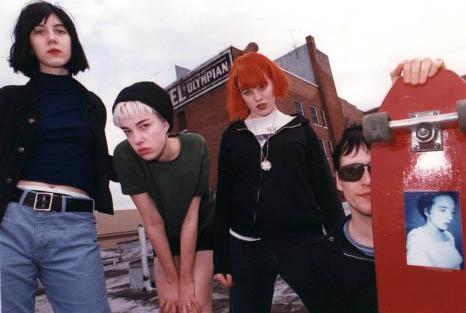
We're pretty fuckin' more punk rock than anybody! Remember, punk rock is about doing things that other people don't do, it's about breaking rules—that's what I mean by that. In that way, it's very punk: don't follow your idea of what needs to be. Therefore, it's not necessarily well-liked, it's underground and it goes against the grain. We have absolutely no "genre," really. We go from doing a blues song, to doing a more rocking song to having a jazz thing. The fact that our parts play so much and have so much syncopation brings to mind jazz fusion. It's the definition of interesting music that doesn't fit comfortably in a genre. So I go back to punk rock.
by Michelle Mae Orr of the Frumpies This was originally printed in Grand Royal magazine in the 1990's.
Maybe you think skateboarding is only a sport. Maybe you think that to be a "skater", you have to know tricks. Maybe you think that being a girl restricts a person's ability to be construed as a skater, or that it restricts the drive to utilize the versatility of skateboarding for one's own purposes (due to possible ridicule). Maybe you've just given up on it after the rash of adult backlash claiming that skating is a menace to society and that we need judicial statutes - enforced by the cloven-footed, blue-uniformed, robotic and senseless entity named "Police" - that prohibit skating from being done at some of the best places to do it. Maybe you need to wake up and smell the pavement.
Sometimes I think skateboarding has become another product of the institution-mindedness of our culture. It needs to be recognized that s.b.ing is not only a competitive sport but a really fun pastime (that's how it started out, anyway). It is also a great form of transportation and an especially fresh substitute for bike riding. You can become a good skater without knowing how to do tricks. I used to feel sort of incompetent for not having the ability or desire to do tricks, stunts or even halfpipe skating (mostly from having a fear of injury). Consequently, I felt less inclined to skate around in my feeble amateurism. Then I realized what a bogus institution I was holding myself to, so I just started skating all the time, and I became pretty good and relaxed with less fear and more control of my board. Also, those little bean wheels you see on almost every board now are mostly good for tricks. Bigger wheels, which are hard to find now, are better for speed and travel.
It's true that the majority of skaters have been boys, but girls are skating more and more. Why has skateboarding been so male-dominated? That's too convoluted a question to answer at this point. I just hope that its versatilities - which I'm trying to expose here - will help girls and boys who are insecure about skating develop a renewed vigor. I also hope a gender barrier doesn't get built, but rather that the scene meshes so a girl on a board ceases to seem like such an oddity. I've already noticed that the scene is being slightly mediated that way. Ever since more girls have started skating, the marketing antics have started exploiting it in a semi-separatist way - like when skateboards are designed to be especially feminine - which is cool as long as it doesn't get condescending.
Another fucked up dementia that sparked my awarenes to this subject was the following example of a scenario that I find particularly sickening. I stopped off at the corner market, where I saw a girl I knew as an acquaintance, and in her shallow-minded stupidity she remarked, "That is so weird that you skateboard - it looks so funny!" I asked why, and she said "I'm so sure! You're 22, a girl and totally not dressed for it." Whatever.
Oh yeah, wearing skirts is cool but when you are in an especially skate-for-transportation mode, wearing pants is so convenient. You never know when you are gonna have to grab your board and hit it.
And as for Fascism Against Youth, and all other miniscule abstractions that prohibit skating - skate where you fucking want. From all of this, let it be known to those it might irritate: I'm not dissing, nor do I think I am an authority on the total skate scene. This is just insight into a multifaceted pastime where some of its Kicks Affirmative Potential has been forgotten and turned into a competitive, jockish and elitist sporting ritual that smells too much like The Man.
addendum to the nu skate movement
by Tobi Vail of the Frumpies
I have skated on and off since 1979, and by accepted traditional skating norms, I "suck". I can't even ollie. This doesn't mean I'm not a skater. Fuck the rule that says you can only be considered a skater if you are at a certain level of achievement. Don't get me wrong, I would personally love to be able to do tricks, ride skate ramps, go faster down hills etc, but the fact that I can't and probably will never learn if I haven't already at this point doesn't mean that I will ever stop skating. I skate for fun (to refer to the greatest skate band of all time) or not at all, dears (Frumpies say dear instead of dude). So there.
It would be nice to hear from other Skate Punx with either similar or conflicting ideals. We would especially like to hear from girls who skate. If you are a girl or a lady who skates exceptionally well, please don't take personal (or gendered) insult at our admitted incompetence. We admire your capability while we simultaneously cherish our own inability; we are just sick of being insulted by usually boy criticisms/suspicions/disses. Make up your own rules! Skate creatively, skate to entertain, skate to challenge accepted skating norms, etc.
write us at : Vail/Wilcox P.O. Box 2572 Olympia,WA 98507 USA
K Records is doing a cool subscription-only MP3 series called the K Singles Zip Pack. Check it out:
The K Singles Zip-Pak is a series of downloadables available exclusively by subscription. The songs are drawn from our upcoming hardcopy releases like the International Pop Underground series of 7” records, the Dub Narcotic Disco Plate singles and the regular album releases and show up in your in-box as MP3s. A year’s subscription to the K Singles Zip-Pak means hundreds of new favorite songs, six or more weeks ahead of their regularly scheduled street date. It’s a noisy pop rockin’ overdose: no post-rock, no Dad-rock, just endless screaming, crying and carrying on compressed into bite-sized chunks of three minute pop songs. Passionate music for passionate people, the K Singles Zip-Pak features the latest in K MP3 delectability, new songs by Chain & the Gang, LAKE, Karl Blau, the Hive Dwellers, Strange Boys, Jeremy Jay, and so many more. Subscribers hear the songs weeks before the rest of the civilized world has gotten an inkling of what the future has in store because the K Singles Zip-Pak is the future, in a neat pak-ette.
I like the idea a lot but keep forgetting to write about it. You get a link to click on, download your songs and then drag it into yr music playing program. It's easy to kind of forget about it until one of the songs randomly plays and you are like, "hey wait, what the heck is this?"...call me old fashioned, but I'm still in the mindset where a record is a tangible object you hold in your hand.
This week I got a few MP3's by Calvin Johnson's latest act, The Hive Dwellers. I was listening to the song Lazy Mondays and thinking, hey what does this remind me of? I was like oh yeah, The Go Team song Three Ways to Sunday and then I remembered that in the late 80's The Go Team tried to have a monthly subscription series of 7" releases and how stressful it was to get all the records out on time and in the mail. I think the MP3 world makes this idea a more doable project. It just took the world 21 years to catch up to Calvin's idea! He is a visionary after all!
I wonder if this kind of thing will catch on. It's a good idea and cool to see independent record labels getting creative, thinking of new sustainable ways to distribute music that actually benefit the artist.
My current musical crisis…is that there are a lot of bands that sound good to me….like Tyvek or Weekend or whatever…the first Crystal Stilts LP for example… Sic Alps...but it's not enough, something is missing like The Comet Gain song says.
The recent revelation that Moe Tucker is a spokesperson for the Tea Party means the VU style floor tom/bass drum pounding beat is no longer the sound of the revolution to my ears. I'm playing drums and I'm hearing Fox TV bullshit suddenly. It's disorienting.
Ever since that whole preppy/African trend happened in indie rock, the question is no longer "is this band radical or complacent" in my mind, but "could this band actually be made up of right wing, racist republicans"? And with "gentrification punk" and the boutique-y/cupcake climate spreading like condos, is it really enough to make a cool sounding record? Was it ever?
I remember thinking about this the first time when Pavement were popular in the early 90's. It's not that their music was bad (some of it was good I thought) it was that they didn't seem to stand for anything. Then I saw Clinic in the late 90's and I really thought it was over. This band sounded cool, sonically referenced Wire and other great post-punk guitar bands I love, but they seemed to mean nothing, they didn't matter. Or at least not to me.
So now when I hear a record I like, I don't know, I just don't really care as much as I used to. I want to know what the lyrics are, who the people in the band are…what does any of it mean to them? So they like Joy Division, the first Jesus and Mary Chain LP…so do I. But do we have anything else in common? I find myself asking people "do you think this band votes, are they liberal or conservative?" and then I'm like, what the fuck...it's the mainstreaming of indie rock...I mean whatever happened to real political discourse...I miss the anarchists and socialists of my youth. And it feels like cultural appropriation...or like something has been taken away in the buying and selling of independent music...the context changed.
So this suspicion cumulated into a general distrust of today's independent/underground music scene. And I'm back to listening to punk/hardcore again. There's a cool local punk scene and lately it's been awesome to see a lot of girls/women getting involved and starting bands (have you heard The Hysterics demo??? Hell Woman? Blood Bones? Weird TV?!!! Son Skull???), but punk has to matter too. At least the people in the bands have to believe in what they are doing. Does being in a band mean anything to these kids or are they just killing time until they decide to get back to their "real lives" or whatever? I don't want to be some old geezer who is like "when I saw Black Flag or The Wipers" bla bla bla like a nostalgic Bruce Springsteen song about nostalgia, but seriously, where is the sense of purpose? What does it mean to be in a band right now? And if your band is an exception to this climate, by all means send me your demo! My ears are dying for it. In the meantime I will be over here listening to Mecca Normal and Comet Gain and trying to write songs worth sharing with you.
But of course even when things get bleak there are musical moments to get us through…in the past few weeks I saw Weird TV play a great show at a house party, walked a few blocks and saw Joey Casio perform his poetic revelry to punk perfection. Last weekend I saw a pretty cool sounding band called Dragging an Ox Through Water (pdx). Helll (Tokyo) also played, a drone/noise band in the vein of Deerhoof/The Punks, though not rocking at all, they were contemplative and sounded interesting. Then Tara Jane Oneil played a mind blowing set, an improvish/loop station-y droning soundscape of abstract shit, interrupted by a stunning cover of The Rainbow Connection (Kermit!!!!!??!!!). She ended the show with a cool rendition of her song Dig In, where she threw bells and shakers out into the audience and we were all stomping in time with the amazing Danny Susaki on drums. Seeing these shows was great fun and reminded me that what I like about living here is that there is a community of people who play music and support each other and it doesn't have to be "genre specific" or closed-minded at all. You can go see different kinds of shows and get something out of it. Part of what is rad is that it's not consumer based, everyone participates.
I'm really looking forward to seeing Wild Flag on Wednesday and The Need/The Gossip at The Capitol Theater on Saturday. I know that music matters to these folks and I'm sure that music will mean something to me for those few fleeting moments and this is still what I hold on to and live for when I'm trying to come up with new sounds.
What means the most to you? It means so much to me!
Girls To The Front: The True Story of the Riot Grrrl Revolution by Sara Marcus came out today. I read it straight through when it came in the mail without stopping. It took about six hours. I thought "oh I'll write a review, but I have plenty of time, it's not coming out for a few months". Then I got an email from Johanna Fatemen where she mentioned she was reviewing it for Book Forum, so I decided to wait. I'm glad I did. Jo is a really, really, really good writer. She's one of the smartest and more captivating writers-who-wrote-zines-in-the-90's for sure--definitely in my top five favorites of that era of feminist fanzine writers. If you ever get a chance to read her zines you totally should do that: Snarla, Artaud-Mania or My Need To Speak on the Subject of Jackson Pollock are the ones I remember, but she may have written more. I'm imagining you finding her work in a zine library or in a musty archive or perhaps in PDF format or maybe will get a shitty xerox sold on eBay for too much $. Please sit there and read everything she has written, you will be grateful that you did and your life will be altered and enriched and you will want to make art or culture or just plain want to make something happen.
Johanna's review of Sara's book is pretty favorable, but there is a hint of criticism lurking underneath the surface. That is the part I would have liked to have read more of, but I understand she is writing the review for Book Forum. If I was reviewing this book in a pretty mainstream publication with a wide-audience I would give it a good review too. I am giving it a good review now. I liked the book. When I was done reading it I wrote to Sara Marcus and said something like "Dear Sara Marcus, Thank You For Writing This Book. I Can't Imagine How Much Work It Took. Wow! You Really Did It! Congratulations!" and mentioned that there were some things I remembered a little differently…other things I didn't know about….but really the emotion I felt when I was done reading the book was appreciation and relief and while I was reading I was totally consumed by it, not noticing that any time was passing at all. So yeah, I like the book, some things I liked about it more than others. You should read it and make up your own mind though and post your review so that there are multiple feminist voices discussing this representation.
Whenever one of these books comes out, I get a little nervous about how I will be represented. I felt a little odd about that in this book, but I tried not to let my self-image issues get in the way of my perception of the work as a whole. My own relationship to riot grrl is complex. Riot Grrl would not have happened without Bikini Kill for example, but I identified as a riot grrl for only a short time, when it had two "R"'s instead of 3 maybe. Who added the third "R"? This is a real question?! Riot GrrL/GrrrL started in Washington DC in June 1991. But it really started the year before that in Olympia, WA. Girls To The Front explains that history really well I thought. I moved back to Olympia (from DC) at the end of 1992 and the third "R" had been firmly established. It was at this time that I finished writing Jigsaw #5, which documents a pretty hard year, Fall 1991-Fall 1992. By the way if you are 23 years old and you think you should write a fanzine about everything in your brain you might regret it later because it turns out that fanzines are not ephemeral art after all, they actually last forever! I guess if you are that age now (or way younger even) then you have no illusions about anything being temporary because you grew up with the internet and you don't care about privacy. Well, I made 10 copies of Jigsaw #5. Yes, 10 copies. I am serious. It's about 92 pages long. I couldn't afford to print them. I sent them to 10 people. A few years later I printed 25 more copies. At the end of the 20th century I published Jigsaw #7 and printed about 20 more copies of Jigsaw #5 to send to friends and that was it. So even though that fanzine seems like it may have been written for a lot of people to read, I tried to keep it a secret.
There are a lot of reasons for that deliberate decision, but I think the best explanation is that the overnight success of Nirvana changed everything. I had been going to shows in Olympia since 1983, so when Riot Grrl (with one R) was formulating- pre-Nirvana success story-we were still thinking in that 80's mindset. The 90's hadn't happened yet. We were living in an underground culture that was being turned into a commodity and sold back to us, which was really disorienting. It is impossible to explain this, because it was so different, but if you use your imagination maybe you might understand a tiny bit. So when everything changed, it felt natural to take a step back. It was confusing. I was confused. Bikini Kill was confused and suddenly "riot grrRl" had a media created-definition and that was not the sound of the revolution because the media was sexist and all about selling shit and we wanted to destroy society. (Later it became obvious that the media had a positive impact as well as a negative one, but that was not clear at the time.)
Jigsaw #5 basically kind of says "fuck you" and "get away from me" and "we don't need you" and "we go with the kids yeah yeah yeah yeah" over and over and over again, in an attempt to navigate the distance between the 80's underground idea and the early 90's pop culture crap that was for sale at the mall. I was trying to say, "hey let's not all become capitalists, let's try to make something revolutionary happen." But I was also freaking out and fluorescent lights were shining on us and we were naked and lots of flashbulbs were going off and people were being exploited and no one had any money. Ok, well some bands on major labels did, but nobody in a "riot grrrl" band was getting paid, but a lot of money was being made off of our image. It's fine to make shit for free, but to make shit without a profit motive and to see something you helped create being used to make money for corporations without your permission totally sucks. So Jigsaw #5 uses terms like "squares" a lot, to try to set up the idea that if you are against capitalism, you are not interested in "the square world", you want to create an alternative, where making money and being successful in those terms is not the point of art or music or whatever it is you do.
I feel like I need to explain this, because Sara Marcus quotes Jigsaw #5 in her book. In fact, she kind of uses a quote from me in her book in a pivotal way in the story arc. I wrote a long-winded Gertrude Stein-meets-Jack Kerouac inspired rambling girl of an essay that tries to address this 80's underground mindset collision with the still emergent 90's pop culture reality where I say that I do not identify as a riot grrrl anymore and say some kind of insulting sounding stuff about "well intentioned hopelessly enthusiastic isolated young girls who still feel that label is meaningful to them". Looking back on this now, it sounds really harsh! But I am me and I can remember writing it and I know what I meant at the time. I was ready to give it up and start something new! I wanted to move things forward. I thought that it had become meaningless and that we needed to start the next era. It had seemed miraculously easy to make riot grrl happen, so why couldn't we just re-invent punk rock feminism again and again and again? In fact, isn't that what we are still doing over and over and over again even now in the year two thousand and ten?!!! We are still making things happen, creating independent culture, self-representing, making work, participating in community life, sharing ideas, listening to each other, disagreeing, discussing, making mistakes, learning and living our lives with our eyes and ears and mouths and hearts open. Right?
History is tricky. For instance now everyone calls that whole time period of punk feminism "riot grrl" and it has a much broader definition than it did back then. There is a market for "riot grrl" history, so we have to be suspicious of that economic factor but we shouldn't let this stop us from documenting our own scenes. Nostalgia is the enemy. Just look at what happened to the baby boomers. 60's radicalism was actually radical, but you have to unearth that radical history, it will not be handed to you. Read Marissa Magic for more on this theme.
Bringing up the question: Is punk rock feminism dead? No. Is "riot grrrl" dead? Well I will not make that claim now because in retrospect, it was certainly not dead in 1993, it had relevancy to all kinds of girls then, even if I no longer felt it was a useful term, and I think the same is probably true today. In fact I know it is true, because I get letters (ok emails) from girls all over the world all the time who tell me they are riot grrrls and love Bikini Kill and that they believe in "The Revolution, GRRL STYLE NOW!" By the way, I still think that the emphasis needs to be on "now" and "revolution" rather than on "grrl" or "style", but if you disagree, please let me know why! But if you are a Riot Grrl then own it! Don't get all caught up in early 90's retro crap. Start a fucking riot!!!!
Riot Grrl belongs to whoever needs it and believes it has the power to give their lives meaning and change things. That is the reason for all of this. Change the world. Don't accept things "the way they are now". Create your own meanings. Make your own definitions. Use culture as a tool. Just know you will have to be quick and constantly on your toes and maybe it's harder than ever to create something ephemeral, to live in the moment, but maybe it's even more than necessary now. The now of now.
If you are interested in starting a young feminist movement rooted in your generation, my advice to you is not to let anyone stop you. People will laugh at you. Ignore the sound of their voices and listen to your own. Scream if you have to, even if you think that no one can hear you. If you are actually threatening the status quo you will not have the approval of the status quo. Call it whatever you want, the point is to fuck shit up. This is true for feminists of all ages and eras by the way.
And never forget what Ari Up taught us: silence is a rhythm too.
I'm not a conspiracy theorist, but I read blogs by scientists And I believe they know, more than we are being told By the mainstream media sources who want the truth to hold it's horses so there isn't mass hysteria as the sea floor erodes
And those in and on the ocean all say hey what's this commotion and they try to get away but they are moving in slow motion because their bodies are so heavy from a substance thick and deadly they say I don't want to die It's all your fault I wasn't ready
I'm so sorry and I'm scared and sad and mad and unprepared to see the stuff that's in the sea evaporate into the air where it will gather and form clouds that travel north upon the wind and drop their cool refreshing poison raindrops on our crops and children
on our crops and children.
So this may be the end I've always thought the end of man would be exactly what we need for the earth to stand a chance And I always thought I would be fine If this happened if my lifetime But now that I'm a mother it seems much more terrifying
And I've always identified with a turtle's soft insides Because there are times when I really need to hide But even the strongest, hardest, thickest shell is not designed to survive, to survive, to survive
Something of this magnitude
Because water is fluid and oil is crude
And it billows way down deep and it sticks to grains of sand And it floats upon the surface where the birds all try to land And the marshes are all ruined and ecosystems destroyed And the people all along the Gulf Coast are now unemployed
While the men who cut the corners still scream DRILL, DRILL, DRILL from their yachts so far away and their mansions on the hill And they turn away the cameras and scream KILL, KILL, KILL As they light endangered sea turtles on fire
They light turtles on fire (I'm on fire)
Because the seas are all connected, And we are all connected And you are in denial if you think you won't be affected You can't hide behind your flag because water knows no border It will creep in every crack and seep in every pore
They lie about the numbers the solutions are illusions But no cover up can hide this huge of a contusion On the face of our mother, that's right, mother earth Is the cost of every living thing what your product is worth?
Well, we are all afflicted with an underground addiction will our desire for convenience be the cause of our extinction? And the industry's the master and we are all the slaves And we're DRIVING, DRIVING, DRIVING to our GRAVES, GRAVES, GRAVES
We must teach our kids to love themselves and let them live their lives What will they be if they grow up? Whatever they like. It's crucial to raise children who don't do what they're told Who will fight for what's right and who can't be bought or sold
I want nothing of this business I am staying underground And I'm gonna ride the railroad and let my guard down We can forage, and ride bikes, and jump in lakes, and go on hikes We can sing and sing for hours and click LIKE, LIKE, LIKE
When somebody posts something good we share and spread the truth It's time to define what success means to you I hope my kid will never be another cog in their machine Trapped inside a box trying to remember her dreams
They will sell us all out for their GREED, GREED, GREED As we cry for the earth as she BLEEDS, BLEEDS, BLEEDS
So hold on to your loved ones, yeah, hold on for dear life Try to walk like thunder leaving footprints that are light Hold on to your loved ones, hold on for dear life Try to walk like thunder leaving footprints that are light
Footprints that are light.
I'm not a conspiracy theorist, but I read blogs by scientists And I believe they know, more than we are being told By the mainstream media sources who want the truth to hold it's horses so there isn't mass hysteria as the sea floor erodes
And those in and on the ocean all say hey what's this commotion and they try to get away but they are moving in slow motion because their bodies are so heavy from a substance thick and deadly they say I don't want to die It's all your fault I wasn't ready
After I wrote my review of Girl Power by Marisa Meltzer I went back to read the email interview I did with her for the book. Not surprisingly a bunch of quotes she used were edited in a way that sort of changed their meaning. Several came from the body of emails I wrote her about why I hadn't gotten around to answering the interview yet. I guess it's naive of me to think that those emails were off the record, but I did assume that at the time...to have them quoted outside of that context felt a little weird but whatever, it's ultimately my fault for not being clear or guarded enough.
Regardless, I feel it's more than fair to quote from the emails given this situation. Anyhow here is one Q & A that I thought would be interesting to share, given the nature of my criticism of her book.
I'd be interested to hear how you all would answer her questions.
Marisa: How do you see the purpose of the underground? Is it inevitable that the mainstream will coopt subcultures? Is it our job to keep them pure? Is purity a good or bad thing for the underground?
Tobi: Hmm….the underground is where I am at….does it have a purpose? That is kind of like asking, does Olympia have a purpose? Or maybe, what is the purpose of Astoria? Or what is the point of Anacortes? These are places where people live. We don't all live in New York or LA and we don't all need to look to those places to be entertained or buy stuff from. We can make stuff and entertain ourselves where we are with what we have available to us.
I guess it's like asking, what is the purpose of folk music? What is the purpose of people sitting around a campfire and playing guitar? What is the purpose of having someone over for dinner? What is the purpose of growing your own food or making pickles?
As far as co-opting, that is a very good question…it can be disconcerting when that happens, but what I like to say is that the mainstream can change the meaning of something, sure, that is inevitable, meaning is not fixed and it changes.
The second part of this got lost in the email shuffle. To paraphrase the idea:
The mainstream cannot take away our ability to create new meanings. Culture then becomes an arena of political struggle where dominant meanings are contested. This is largely about hegemony. Power. Who has the upper hand and how can we be persuasive?
As far as women go, there is patriarchy to consider. How could riot grrl become mainstream without its meaning changing? The mainstream is patriarchy. Riot Grrl is feminist. Something has to give, right? I guess that's why we have The Spice Girls.
I'm not sure how to address your question about purity, can you give me an example?
I think that was the end of our discussion on this point... Photo: Ernest Arnold (Grandma's brother) and Nellie Brown (a friend)
Girl Power traces the influence of OG "riot grrl" groups (Bikini Kill, Bratmobile, Heavens To Betsy) to the Spice Girls, covering "foxcore", Sleater-Kinney, Le Tigre and Ladyfest as well as several other pop stars and other all-female alternative/indie rock groups along the way.
The book is written for a mainstream audience and suffers from some of the awkwardness that comes along with trying to explain this stuff to the general public. Marisa comes across as a former indie-rocker who felt she didn't really fit into the punk scene, yet was invigorated by the feminism (and celebration of girlhood) that happened during riot grrl. This makes sense, as she admits she found out about the movement through Sassy (her previous book is a love letter to the pro-girl teen magazine) She argues that riot grrl's "media blackout" led to its demise and wishes that the original groups would have stuck around and tried to find a larger audience. Describing an experience of seeing Sleater-Kinney play to 13,000 people, she recalls wishing that riot grrl had been able to sustain itself. Paradoxically, she acknowledges that, while the Spice Girls were cool in some ways, their "girl power" was limited to marketing and questions what that means in terms of empowerment. Quoting Kathleen Hanna, she points out that buying a Spice Girls notebook is not going to change the world. This makes me wonder what would be different if it had been Bikini Kill notebooks the girls were buying.
I knew Marisa around 96/7 when she lived in Olympia and had a cute all-girl accapella group called The Skirts. In the interest of "full disclosure"--I was a big Skirts fan and she was my favorite member! It was a weird time period. It was interesting to read her take on things as someone who admits (somewhat reluctantly) that she moved here to go to Evergreen after getting into riot grrl and even "semi-stalking" Kathleen. I wish she would have told more of her own story here. Her voice comes through loud and clear when she is critiquing what she calls the elitism of independent culture. She belongs to the camp that believes that it's exclusive to play basement shows, failing to see how this can be a more inclusive model. By booking our own tours and creating a DIY feminist network through the mail, Bikini Kill encouraged girls to meet each other and start their own scene. Sure a "scene" can be clique-ish and Olympia was/is no exception, but the idea we were were working with is that if we can do it here, certainly you can do it where you live. Only a few bands can get on MTV or sign to a major label. It's far more populist to encourage kids to put on shows where they live and take their own work and friends seriously. To her credit she does acknowledge that Ladyfest was a successful attempt to take this idea to another level.
I was interviewed (via email) for the book and am quoted a lot, which is kind of embarrassing, as I don't think what I'm trying to say really comes through, which is partially my fault, not thinking about who the audience for the book would be and just neurotically rambling on to her about how strange it is to have been a part of something that had such a big cultural impact. I remember telling her how weird and hard to talk about a lot of this is for me without going into a lot of detail. I tried to explain my perspective. On the one hand you want to take credit for your work, especially because women are encouraged NOT to take credit for anything. On the other hand, it's embarrassing. Sometimes I feel like I'm lying when I talk about this stuff because what actually happened is so surreal and bizarre that I often have a hard time believing it myself.
Personal weirdness aside, I think it's cool that someone wrote this book for a mainstream audience. My hope is that teenage girls and young women who don't know this history will get inspired to find out about riot grrl. It would be really cool if it inspired girls to create a new young feminist movement rooted in their generation.
The book made me think a lot about documenting history from a strategic perspective. How could this story be told to incite participation in girls? A big part of the original "girl power" idea, was to get girls to stop being consumers of male-dominated culture and start producing our own. I guess my fear is that this kind of pop-culture history could encourage girls to simply consume "girl-culture", thereby claiming the identity of "riot grrl" or "feminism" through the act of buying a record, as opposed to starting their own band or fanzine or putting on a show. To me the point is to encourage girls to start their own young feminist movement, not just to copy what we did. That is the danger of nostalgia I think...
So I'd be interested to hear what people think about this. How can we tell our story without feeding into this consumer-oriented nostalgic trap? Or is that inevitable?
Underground refers to music that has a different purpose and orientation than mainstream bands. Keeping underground as an ongoing description illuminates that there is an under to the over -- a distinction that implies motivations other than money and fame. To reduce underground to a description of current trends diminishes its potential power. I guess there are now indie bands on major labels, diluting the reason there were indie bands. Indie is now a genre where previously it was a stance. Maybe we'll have "undie" bands in the mainstream and the history of underground culture will likewise fade.
I started writing about The Jigsaw Underground as an entity in my fanzine Jigsaw around 1991. I would define it in each issue, but basically I would pick a different selection of bands to write about that existed for reasons other than "to make it big"....bands that I thought were culturally and/or politically significant...bands that symbolized what it meant to be independent or punk at that particular point in time. Looking through the back issues, this is something I was deliberate about from the beginning. Through the creation of my fanzine I hoped to be able to change the direction youth culture and punk was going. In the late 80's/early 90's when I started writing my zine, I felt a lot of people were into blatant marketing and career goals. Sub Pop symbolized this to me with their limited edition 7"s, insult-your-intelligence and tell you what to do ad campaigns and "professional" looking logo/graphics. From today's vantage point, it's a little hard to refer to what I was thinking at the time without writing a whole essay about it, but hopefully you can get the picture.
When I decided to start Jigsaw as a blog version of the fanzine one of the things I wanted to focus on was the "underground" part, particularly because of how the internet has changed things. Like Jean Smith, I don't think the idea of an underground has lost relevancy just because the internet has changed how we access information. I think the concern now, is to get people in bands to stand for something and to stand together against multinational corporations, global capitalism and consumer culture. How can we use independent-punk-underground music culture as a site of resistance? How do we define ourselves in opposition to the mainstream, when the mainstream is everywhere?
One of the challenges that I see in this era, as both a working musician and someone who works at an independent record label, is rooted in economics. On the one hand, I resisted turning punk rock into my job and try not to approach music from a careerist or commercial standpoint. On the other hand, as someone who has toured extensively and is dedicated to distributing independent music world wide, I want working musicians to be able to make a living wage and get health insurance. This is a tricky issue, because it involves capitalism, market forces and art making and so there is going to be some degree of compromise involved. Some would say there are irreconcilable contractions at work. But I don't think that just because bands are forced to navigate economic concerns we should abandon ethics. Part of this is about supporting touring bands when you go see them by buying a T Shirt or a record as an ethos. Why do so many people think it's totally ok to spend $20 going out to dinner and $20 on drinks and then totally freak out when they have to pay more than $10 to go to a show? Make a sandwich! Drink another night--or not at all, how's that for radical! Put your hard earned money back into the community don't fund the consumer bar culture and support the beer and cigarette companies. Let's make economic sustainability a value to work towards, something similar to "buy local", but in this case "buy underground music", "pay generously to see touring bands" "fund independent culture"...you get the drift.
I strongly believe that if there are people who are listening to your music and coming to see your band live that you should be compensated for your work. I also believe that you should not have to sign to a corporately owned major label in order to do so, especially not today, with digital music being a growing percentage of total sales. Of course with free downloads, it is harder for bands live off of royalties. Unfortunately, economic reality has made it difficult to make money on tour as well. This is largely because although the cost of gas, food and lodging has increased exponentially in the past 20 years, punk bands are still expected to charge the same amount at the door--locally, under $10, usually $4-$6. In Olympia it is actually really hard to get people to pay for shows at all because there are so many shows happening all the time and a lot of them are free. While on one level, this is really cool, it has a real, negative economic impact on touring bands. (Incidentally, this is largely the reason most bands that are trying to make a living off their music skip Olympia on tour, no one can get paid enough here to make it worthwhile.)
When asked about the economics of touring as an underground band today, Ian Svenonius (Chain and the Gang, Make Up, Nation of Ulysses) said:
I guess touring is harder now but I also think maybe it was always pretty untenable. Unless you're the hot band of the moment, its pretty ridiculous proposition. Four or five people hauling gear around in a van hundreds and thoudsands of miles to perform something that, by its own design, can be made by anyone (i.e. "punk"). The big diffrence now is that so many bands are touring all the time and that so many have promotin, tour support, and publicity or are internet savvy (i.e. phenomenon bands like "Wavves") in a way that some of us are not. But yes, the punk politics have disappeared but the inherent cheapness of that scene is still with us (i.e. everyone wants everything for free).
This begs the question, how do we change this, how do we bring "the punk politics" back or update it for the present/future? What would that entail exactly? What is our political platform? What needs to happen? What tools do we have available? What do we want to change? How can things be improved?
When I asked Jean to clarify what she meant in her original quote when she said "the history of underground music will continue to fade" if underground becomes another mainstream marketing category, she replied:
The history of the word indie continues to fade. People who hear it, and use it, forget that it meant independent from major labels. Now indie is mostly a description of a sound, like alternative is a description of a sound rather than an alternative to how the music industry operates. Alternative was a description of the way bands operated -- putting on shows, working with a label to get your music out as opposed to being a rock star on a major label with staff to handle such details. Both these terms -- indie and alternative -- have been assigned new meanings that relate to the descriptions of the sounds associated with them. I'm sure if there were "undie" bands it would almost immediately turn into something to do with underwear. Bands would play in their underwear. Calvin Klein would start making music videos in its newly formed record label division. The history and meaning of underground culture would no longer be there when the word "undie" is used. I don't believe people think about independent culture, independent from major labels and corporate concerns, when they hear the word indie. Grunge is a sound and a look -- perhaps a city and a handful of bands. Indie is a political stance whose history is being replaced by a sound, a look and an era.
I am tempted to make a joke about Hawnay Troof, who often do play in their underwear, as a proto-undie band here...I can imagine people writing dissertations on the intersection between "undie" and riot grrl based on outfits alone...but what I'm seriously getting out of this discussion so far, is that "underground" is now, more than ever, a political stance more than a location. If that's the case, let's keep talking about what it means to be "an underground band"... the interactive nature of the blog format makes it possible for us to talk about this here in the fanzine at the moment it is being made. I am happy to provide a forum where we can have this conversation.
I leave you with this encouraging statement from California based punk singer Robin Indar (Black Fork, Severance Package) about how touring in a lot of ways is easier now than ever before. I also asked her what it was like to go on tour as parents:
Well, from what I've seen, there's not too many people out there in our predicament (parents of two/ rock n' rollers) but I know of at least one couple here in town that does, but they're at least ten years younger. Without the added chaos of small children, I would say touring is easier than ever. You can post flyers on the internet instead of mailing them or hoping people will post them in their towns and you can make flyers easier, faster and in color (ooh!) without having to know someone at the local copy shop. Most of the booking can be done online as well so you save on all of those long distance phone calls from hand written wads of paper your friends lent you from their last tour. I'm especially fond of the option of burning a CD demo in 20 seconds versus dumpster diving old cassette tapes, covering the holes up and recording over them so you'll have demo's to sell at the show. We used to get the occasional customer that would return saying "that demo I bought was all psycho Christmas rap songs". I've been really surprised to see bands on tour with van rentals that have GPS systems. That was completely unheard of ten years ago. Think of all of the combined hours of lost punks driving around on the wrong roads. For those without GPS, there's always google maps which will give you the exact directions, and weather.com to tell you exactly what to expect weather wise and what the road conditions are. Basically, anyone who complains about tour being hard in this new century is either riding a donkey with an amp on their back or they just have no idea how hard touring USED to be. The only thing different for Josh and I, and any other parents out there rocking together in a band is that you have to have someone to watch your kids while you're away and you have to work with their school schedule too. Even our drummer Steve, has a teenage daughter so we're a pretty unusual band as far as responsibilities go. The van is too small to bring anyone but us at the moment so luckily, my mom has gone beyond her call of duty in taking the boys while we attempt small tours. She can even call us on our cell phones should the need arise, oh what I would have given for one of THOSE 15 years ago when we broke down in the scalding hot Arizona desert!
ok thanks to everyone who participated in this week's discussion about what it means to be underground in the digital era. you can read my earlier post here.
This week I was asked to write a piece about this Decade in Music. It was a little hard because, for one thing, what is this decade even called? And for another, that kind of framing device is easier to see in retrospect...but it got me thinking about the underground...some people question whether there is an underground in the digital era...so that in and of itself sort of begs the question: is this framework still useful?
I think it is...but what do YOU all think? more soon
So...I have a lot of opinions and am open about sharing them.
For awhile I was sharing them here pretty freely. Then I pissed some people off and I took a step back to think. I spent the past few months thinking a lot and was about to start posting some writing again when a good friend of mine let me know that some younger women are still mad about me expressing opinions here that they disagree with.
You know what I have to say about that?
Disagreement is actually good.
BABY'S ON A MISSION
The idea that I should refrain from saying something because it is somehow not the 'correct' feminist perspective someone thinks I should have is TOTAL BULLSHIT.
I have opinions. They probably differ from your own on occasion. This is where I write them down.
SO WHAT? I am not asking anyone to AGREE with me. I am not asking for your approval or your permission. You know that, right?
Jigsaw is part self-expression, part artist statement, part spread-the-word, part incite-a-riot, part asking questions because-I-don't-know-the-answers-to-them-yet, part whatever else I happen to be using it for at any given particular moment.
The Jigsaw Underground has ALWAYS primarily been about trying to make something happen by questioning "the way things are", asking, "do things really HAVE to be this way or can we create something different" and trying to figure out a way to do that. I try to ground my critique in an anti-capitalist framework, often bringing economics to the realm of aesthetics. This can be troubling, even to me. Sometimes I just want a pretty picture to be a pretty picture. But other times an aesthetically grotesque indy-rock band (or film, or trend or incident) incites a flury of fury in my heart and I have to go sit in my room and listen to I Hate the Rich by the DiLs until I calm down. This leads to Bad Brains, which leads to Black Flag, which leads to Black Sabbath. Pretty soon it's back to Mecca Normal, The Melvins, Throbbing Gristle, Suicide, Chrome, Flipper, the Raincoats and PUNK ROCK Patti Smith. (YEAH!) On a good day this leads to the practice space or basement or to the typewriter, transforming aesthetic hatred into art-making. On another kind of day it might just lead to a RANT such as the one you are reading now and then that eventually leads to something else--the ripple effect, a message in a bottle, fingers crossed someone finds it and it means something to them.
So yeah...another thing Jigsaw has always been about is PROCESS.
I don't just write shit when I have it all figured out. I often write shit when I am FREAKING THE FUCK OUT and trying to get a grip on WHY. I guess maybe the interactive nature of fanzines on the internet can make that a little weird sometimes, but, you know, so can ZINES that are xeroxed.
I mean, I met most of the people I am closest to through writing this zine. It led to starting every band I've been in for the past 20 years in one way or another, to every major life event I've experienced. Jigsaw is something I made to share my perspective, to give myself a voice in this world. It's how I wrote myself into existence. How I made the transformation from being an OBJECT that was acted upon into a SUBJECT with a fully realized VOICE...how I became an active participant in the world...I'm not going to shut up. There's too much at stake.
I'LL TRY TO SCREAM IN PAIN A LITTLE NICER NEXT TIME/ I'M SO SORRY THAT I THINK
Lately sexism has been bumming me out and I've been trying to talk about that a little and been questioned a lot in a 'please prove that sexism exists kind of way' and I have found myself quoting old Bikini Kill lyrics and looking to old zines. Like "dear idiot, please refer to article 9, page 2 written by yours truly in 1991". I don't want to get stuck trying to explain that, yes, sexism does exist and women are oppressed by virtue of their gender. I don't want to have to make a logical convincing argument to a jerk I don't give two shits about.
I also have been somewhat alienated by the current state of boutique-indy rock or "D.I.Y. culture" that is consumer-driven and into surface-y type concerns. I don't want to just say I like everything that offends me. No. I want to talk about why I don't like shit and what is pissing me off. This is where I want to do that. If you don't like it, please start your own band, i.e. write your own fanzine! Or heck, just write me a letter or a comment and we can have a conversation. Is that really so scary?
HOW LOW CAN A PUNK GET?!!!! I GOT MY ATTITUDE!!!
A fanzine is just a TOOL. Think of it like an amp you plug your guitar into. It can get you from Point A to Point B, it gives you a platform, a means of amplification, a forum. An OPINION is something to EXPRESS, something to USE for FUEL. Like electricity for the amp.
We don't have to have it all figured out before we open our mouths, right? We are not perfect. We fumble, we fall down, we hurt each other's feelings. This is not A FINAL DRAFT. Why pretend and hide the aesthetic collisions?
THE WORLD'S A MESS IT'S IN MY APARTMENT. IT SMELLS LIKE ONIONS.
so, the prospect of another fashion show at the capitol theater is about as exciting to me as getting another tooth pulled...it is reminding me of 8th grade cheerleading tryouts...and while i am used to being alienated by the world at large and the mainstream of indie rock, i don't like it that the thing that the women in my town work so hard on these days is centered around the buying, selling, making and wearing of clothes. i recognize that fashion is considered an art form, and (as previously stated) yes, sometimes i like wearing outfits too, but i am not someone who thinks owning a business or being crafty is in-and-of-itself radical. so while i am hesitant to present my harsh critique here (what i really think would probably offend you) i have to say, no i will not be attending the fashion show or dying the gray out of my hair or putting myself on display any time soon. i am glad that women are being creative together, but sad that i can't relate...oh well i guess. maybe it's time to re-evaluate what feminism is. hmmm.
as an afterthought I should probably mention that i do think a political usage of style, especially with regards to youth cultural movements, (see dick hebdigesubculture the meaning of style or the writing of stuart hall) is viable and can be potentially liberating, though when it comes to girls, focusing so much on appearance is always going to be a double-edged sword...and fashion, as an industry, "diy", boutique or mainstream, is not compelling to me...to each her own i suppose...i know we all have to pay the bills and...i won't voice my critique of the music industry here either, but rest assured i do have one...yep.
when I was in middle school my mom told me I didn't need to shave my legs or wear a bra or make up unless i WANTED to. in high school I found that these "choices" were less than free--if you didn't conform to traditional grooming habits for women, there were consequences. as a young woman, I resisted this programming in different ways, only conforming when I felt it was really a choice or when it seemed to make sense to comply, i.e. job interviews or whatever.
in bikini kill we tried to make the construction of femininity--and resistance to it-- visible as part of our performance. we used style politically. unfortunately this 'style' was commodified and entered the market place in weird sanitized versions...somewhere along the line, "fashion" became "hip" and the trendsetters became trendy.
as an adult woman who will be turning 40 this year, i find myself thinking a lot about what my mom told me in middle school. when i realized i was spending a bunch of money dying my hair because it was turning gray and women are supposed to try and look young forever, i stopped doing it. when i dye it next time it will be because i WANT to, not because i HAVE to if that makes sense.
in all this worrying about my appearance, the fashion show doesn't make me feel happy, it makes me stressed out. fuck it. i want to read books and try to create a world free from war, racial injustice and poverty. that to me is what it's all about. i don't give a shit what you wear. sure it's better to buy local, but do we really have to think about it so much?
Hi. I get these interviews in the mail a lot that are difficult to complete as I often don't know the answers to the questions. Or if I do have something to say, it seems that the writer is looking for specific kinds of answers. So I have been sent some questions for a magazine article and the writer sent this comment as a preface to the interview:
"Essentially, I want to see if there's any sort of potential for a fourth wave of feminism movement, or possible resurgence of riotgrrrl. I also wanted to know what female musicians or even males out there you see are using their music as outlet for change."
Here are the questions:
1. How do you think women in rock music are generally viewed?
2. Do you think that there is any hope for a possible resurgence of riotgrrrl or fourth wave of feminism?
3. What bands do you know are politically/social active? How do you feel about these bands?
4. How do you think women in rock music are generally viewed?
5. Do you think there are misconceptions about females in punk/rock music? If so, what are do you think they are?
Please feel free to send in some answers...I have written to her asking for clarification. In the meantime, I'm interested in knowing what people have to say about question #3 in particular.
jigsaw fanzine rejects the consumerist mode of music writing that is so prevalent today:
1. everyone wants what's new, why?
(marketing, consumerism)
2. record reviews are almost always written BEFORE a record comes out, why?
(marketing, consumerism)
3. why are there only show previews and very few show reviews in the music press?
(marketing, consumerism)
4. i dig fanzines in blog form because they are free, accessible and instantly available as a means of communication. i don't like that the general way people seem to use them is to imitate the establishment music press.
5. now that music blogs are so influential, the establishment music press have blogs that mimic the independents.
6. people are paid to market music to bloggers. are bloggers paid to 'break' bands? what does this economy look like?
7. jigsaw fanzine is interested in documenting, discussing and disseminating information about the underground. we make up our own rules.
I am bummed that the feminists I know are so into fashion these days. I value personal style as a means of expression (sorta) and understand that it is considered an 'art form' but wonder what it means that most women//girls spend so much time on what we look like in comparison to most men/boys in a world where we are still judged by our appearance to a greater degree than most men/boys are. It's something I think about a lot but don' t have much to say about yet, though I will probably write about it at some point. There is a double standard at work that needs to be interrogated before this is just a matter of "personal choice". This doesn't mean I am giving away my berets or beatle-boots anytime soon by the way. I enjoy wearing 'outfits' sometimes too, but I try not to focus on it too much.
the jigsaw underground thinks it shouldn't have to say these things, but is constantly thinking about them.
1. there's no such thing as a "cool" bar
stop wasting your life. the bush presidency is over. time to get on with it.
every second you spend sitting on your ass 'consuming' alcohol is another second closer to death. (idea/terminology credit to joaquin de la puente lll)
you are also spending your time as a consumer. exchanging dollars for drinks. this is capitalism.
if you wanna party, join a beer-making collective or make your own wine. have creative fun times in the woods, at your friends house, host a party!
just get out of the bar!
i realized that by playing 100 shows in 12 months in what was basically a bar-band, I spent 1 out of every 3-4 days in a bar....what is this kind of touring for? you play to drunk people every night why? to distract them from what's really going on? like the wars in Iraq/Afghanistan????
not my idea of punk. time to move on. all ages in 2009.
go to all ages shows and pay to get in so bands can afford to tour this way and even make enough money in their own town to pay their expenses. $8 is not too much to go see 3 or 4 bands. that is the price of two drinks, dear. hardly a fortune. you can afford it. it's a matter of changing your priorities.
here are my personal bar rules:
-try not to go to bars unless something is happening, i.e. dj night or show -if i drink, two drink limit at bar -try to only stay for the show or 1 or 2 hours -try to have interesting conversations with people. if that's not possible, go home and read/write letters or do something fun/productive/meaningful
please feel free to make up your own rules.
2. dismissing something based on genre or hype, is buying into capitalist ways of organizing information.
there are good songs in every style of music, and all musicians have to promote themselves in order to earn a living
not buying coffee at "insert name brand here" because you don't want to be perceived as a certain kind of person, feeds into the idea that a brand or a logo or what you consume is who you are.
similarly, not going to a 'black-metal' show because you are in an indie-pop band or only like country music made in the 1930's is to substitute genres for logos and is another form of conspicuous consumption. obviously this is not a threat to capitalism.
if you are into a certain kind of music, fine, but don't let that define you or close you off to a world of experience.
punk is an attitude, not a style of music, etc.
3. there's no such thing as a cool corporation
sure some pay health insurance and treat their workers well, others don't. that is important to know and take into consideration when deciding how to spend your money and in some cases, where to work.
but ultimately, corporations are part of a system that is destroying the world.
4. talking about ad campaigns is actively promoting word-of-mouth advertising. every time you say "name brand" you are working for the man
this is what I didn't like about Ann Elizabeth Moore's book, although there were things I did like about it.
5. punks are artists/ the punk as artist: being an artist is not exclusive and does not (necessarily) rest on 'talent', 'skill' or 'worthiness'. also, being an artist does not make you a special person. what it does do is put you in a position where you can use symbols to express ideas, and this can be done for incendiary political purposes as well as for fun or to kill time or to entertain yourself, your family, your friends....even strangers. it also provides a connection between you as an individual and the world as a whole in which you are active --as opposed to passive-- which is what you are when you spend your free time as a consumer. some people call this being a producer.
the jigsaw underground says: participate! create! make stuff happen not just stuff to buy and sell! by all means, paint! be a punk rocker!
this means: spend your time questioning the status quo, tearing shit down and creating your own world via your band, fanzine, painting, comic, film, play, novel etc.
by being/becoming artists and creating culture, we can create new meanings that change how we think about and live in the world.
this is based on the idea that language is socially constructed through cultural institutions and that making art is to intervene in the process of how things come to mean what they mean. symbols=language. meaning is culturally contingent. when art is culture and not just in a museum, it has more potential for change. this is where the term 'cultural production' comes into it.
examples:
M.I.A. bikini kill the clash crass sex pistols public enemy black flag bratmobile heaven's to betsy huggy bear minor threat beat happening woody guthrie nina simone bob dylan
please create your own list.
6. the easiest way of defining yourself is by saying 'i hate bla bla bla' i'm different. but like the death by chocolate song illustrates, 'what do you like' is a far more difficult question to answer.
(if you know me, you know this is something i struggle with and that i also value negativity to the point of absurdity/comedy and that it sometimes threatens to take over my entire social personality--yet i wanna recognize its theoretical limits here.)
this is one reason why bands against bush was so easy to organize, yet stuck and unable to move forward.
we are moving out of the bush era, into a whole new historical epoch.
here's my suggestion:
try to come up with a list of criteria for deciding what you like. how would you like the world to change? how could society be organized differently?
in order to do this, in my opinion, we need to critique capitalism in every day language. this means being able to define what capitalism is and identify how it functions in our lives on a day to day basis.
the questions we need to work on:
what is capitalism? how does it function? can it be resisted/dismantled? why or why not/ how?
then do the same with neo-colonialism, imperialism, empire and globalization.
no jargon or technical terms unless you can define them in non-jargon or non-technical terms using concrete examples.
these are theoretical baby steps, but i think that if we change how we think about the world, we can change how we live in it. if we can change how our actions impact the world we live in, that is a step in the right direction.